Every spring, Georgia homeowners get an Annual Notice of Assessment from their county tax assessor. It's easy to glance at it, see a number, and toss it in a drawer. But this one piece of mail sets

Dated: September 23 2026
Views: 2
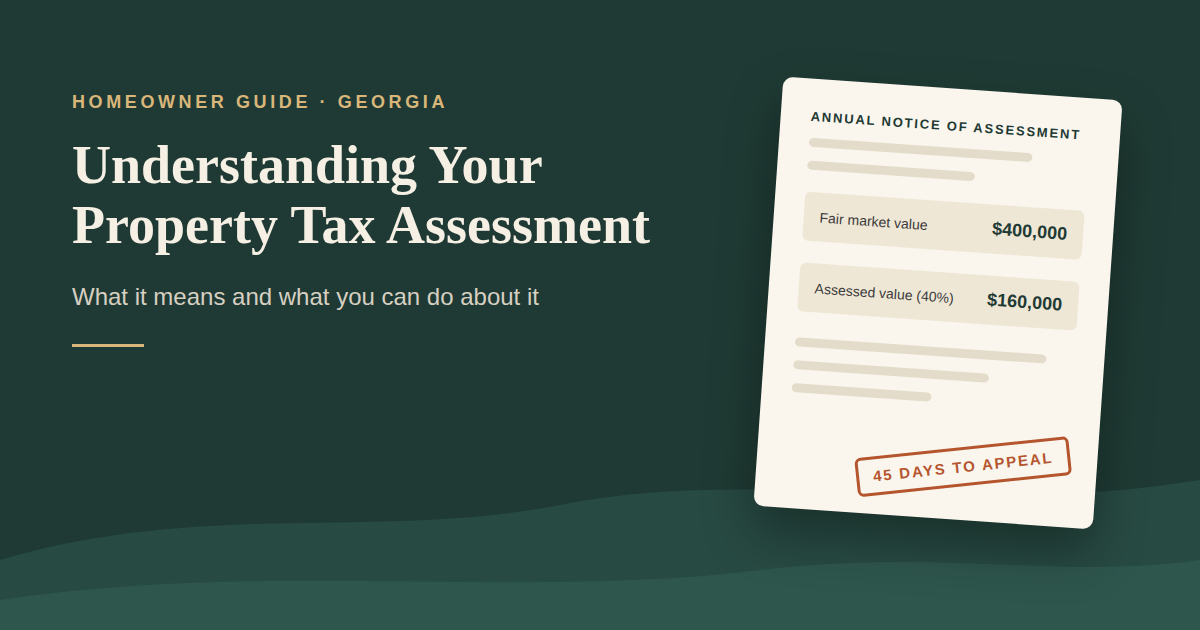 Every spring, Georgia homeowners get an Annual Notice of Assessment from their county tax assessor. It's easy to glance at it, see a number, and toss it in a drawer. But this one piece of mail sets the foundation for your property tax bill, and you only have a short window to act if something looks off. Here's how to read it.
It's a notice, not a bill
The assessment notice is not a bill. It tells you what the county thinks your property is worth and gives an estimate of your taxes. Your actual bill arrives later in the year, once local governments set their millage (tax) rates. Still, the notice is your one chance each year to challenge the value, so it deserves a careful read.
Fair market value vs. assessed value
Your notice shows two key numbers.
Fair market value is the county's estimate of what your property would sell for in an arm's-length transaction as of January 1 of that year. Assessors reach this number using recent sales of comparable properties, your home's size and features, land value, and other data.
Assessed value is the number your taxes are actually calculated on. In Georgia, it's 40% of fair market value. A home with a fair market value of $400,000 has an assessed value of $160,000.
From there, any exemptions you qualify for (such as the homestead exemption) are subtracted. The remaining taxable value is multiplied by the millage rate to produce your tax.
Why the county's number may not match what your home would sell for
The county's fair market value often differs from what an agent would list your home for, and that's normal. Assessors value thousands of properties at once using mass appraisal models. They may not know about a roof that needs replacing, a steep or unusable portion of your lot, or an unfinished basement. They also value everything as of January 1, so a market that shifted since then won't be reflected. Sometimes the county's number is higher than a realistic sale price, and sometimes it's lower.
What to check on your notice
How appeals generally work
In Georgia, you typically have 45 days from the date on your notice to file an appeal with the county tax assessor's office. Many counties accept appeals online, by mail, or in person. Miss the deadline and you generally have to wait until next year.
When you file, you choose how you'd like the appeal heard. Most homeowners go to the county Board of Equalization, a panel of local citizens. Other routes include arbitration and, for certain higher-value non-homestead properties, a hearing officer.
The strongest appeals are built on evidence, such as:
Before a hearing, the assessor's office often reviews your appeal and may offer an adjusted value. You can accept it or continue to a hearing. If your value is reduced on appeal, Georgia law generally holds that value in place for the following two years as well, unless you make significant improvements.
One more thing: you keep paying while you wait
Even during an appeal, a tax bill will still be issued, usually based on a partial or temporary value. You'll receive a refund or an adjusted bill once the appeal is resolved.
The bottom line
Take a few minutes with your assessment notice when it arrives. Check the details, compare the value to recent sales in your area, and mark the deadline on your calendar. If you have questions about your property's value or want help pulling recent comparable sales, reach out anytime. I'm happy to help.
Stephanie Sticker- e: sticksteph49@gmail.com
RE/MAX Town & Country
This article is for general information only and isn't tax or legal advice. For specifics on your property, contact your county tax assessor's office.

Stephanie entered the real estate industry in 2019 and has since dedicated herself to building expertise and providing exceptional service to her clients. Prior to her real estate career, she honed he....
Every spring, Georgia homeowners get an Annual Notice of Assessment from their county tax assessor. It's easy to glance at it, see a number, and toss it in a drawer. But this one piece of mail sets
Title: The Ultimate Home Staging Guide for Sellers in North GeorgiaSelling your home in North Georgia? Whether you're in Ball Ground, Jasper, or Ellijay, one of the most powerful ways to attract
Preserving Land, Preserving Wealth: How Georgia Conservation Use Can Work for YouGeorgia landowners may have more than scenic views and open acreage—they may have access to a valuable tax
 ©2026 Georgia Multiple Listing Service All information deemed reliable but not guaranteed. All properties are subject to prior sale, change or withdrawal. Neither listing broker(s) or information provider(s) shall be responsible for any typographical errors, misinformation, misprints and shall be held totally harmless. Listing(s) information is provided for consumer's personal, non-commercial use and may not be used for any purpose other than to identify prospective properties consumers may
be interested in purchasing. The data relating to real estate for sale on this website comes in part from the Internet Data Exchange program of the Multiple Listing Service. Real estate listings held by brokerage firms other than REMAX Town & Country may be marked with the Internet Data Exchange logo and detailed information about those properties will include the name of the listing broker(s) when required by the MLS. Copyright ©2026 All rights reserved.
Last Updated: September 25, 2026 6:01 PM UTC
Show More...
©2026 Georgia Multiple Listing Service All information deemed reliable but not guaranteed. All properties are subject to prior sale, change or withdrawal. Neither listing broker(s) or information provider(s) shall be responsible for any typographical errors, misinformation, misprints and shall be held totally harmless. Listing(s) information is provided for consumer's personal, non-commercial use and may not be used for any purpose other than to identify prospective properties consumers may
be interested in purchasing. The data relating to real estate for sale on this website comes in part from the Internet Data Exchange program of the Multiple Listing Service. Real estate listings held by brokerage firms other than REMAX Town & Country may be marked with the Internet Data Exchange logo and detailed information about those properties will include the name of the listing broker(s) when required by the MLS. Copyright ©2026 All rights reserved.
Last Updated: September 25, 2026 6:01 PM UTC
Show More...
 Listings identified with the FMLS IDX logo come from FMLS and are held by brokerage firms other than the owner of this website. The listing brokerage is identified in any listing details. Information is deemed reliable but is not guaranteed. If you believe any FMLS listing contains material that infringes your copyrighted work please click here to review our DMCA policy and learn how to submit a takedown request. © 2026 First Multiple Listing Service, Inc.
Data Last Updated on: September 25, 2026 6:09 PM UTC Please contact insiderealestate.com if you experience any technical issues.
Listings identified with the FMLS IDX logo come from FMLS and are held by brokerage firms other than the owner of this website. The listing brokerage is identified in any listing details. Information is deemed reliable but is not guaranteed. If you believe any FMLS listing contains material that infringes your copyrighted work please click here to review our DMCA policy and learn how to submit a takedown request. © 2026 First Multiple Listing Service, Inc.
Data Last Updated on: September 25, 2026 6:09 PM UTC Please contact insiderealestate.com if you experience any technical issues.
 Northeast Georgia Board of REALTORS® All information deemed reliable but not guaranteed. All properties are subject to prior sale, change or withdrawal. Neither listing broker(s) or information provider(s) shall be responsible for any typographical errors, misinformation, misprints and shall be held totally harmless. Listing(s) information is provided for consumer's personal, non-commercial use and may not be used for any purpose other than to identify prospective properties consumers may be
interested in purchasing. The data relating to real estate for sale on this website comes in part from the Internet Data Exchange program of the Multiple Listing Service. Real estate listings held by brokerage firms other than REMAX Town & Country may be marked with the Internet Data Exchange logo and detailed information about those properties will include the name of the listing broker(s) when required by the MLS. Copyright ©2026 All rights reserved.
Last Updated: September 25, 2026 6:04 PM UTC
Show More...
Northeast Georgia Board of REALTORS® All information deemed reliable but not guaranteed. All properties are subject to prior sale, change or withdrawal. Neither listing broker(s) or information provider(s) shall be responsible for any typographical errors, misinformation, misprints and shall be held totally harmless. Listing(s) information is provided for consumer's personal, non-commercial use and may not be used for any purpose other than to identify prospective properties consumers may be
interested in purchasing. The data relating to real estate for sale on this website comes in part from the Internet Data Exchange program of the Multiple Listing Service. Real estate listings held by brokerage firms other than REMAX Town & Country may be marked with the Internet Data Exchange logo and detailed information about those properties will include the name of the listing broker(s) when required by the MLS. Copyright ©2026 All rights reserved.
Last Updated: September 25, 2026 6:04 PM UTC
Show More...
